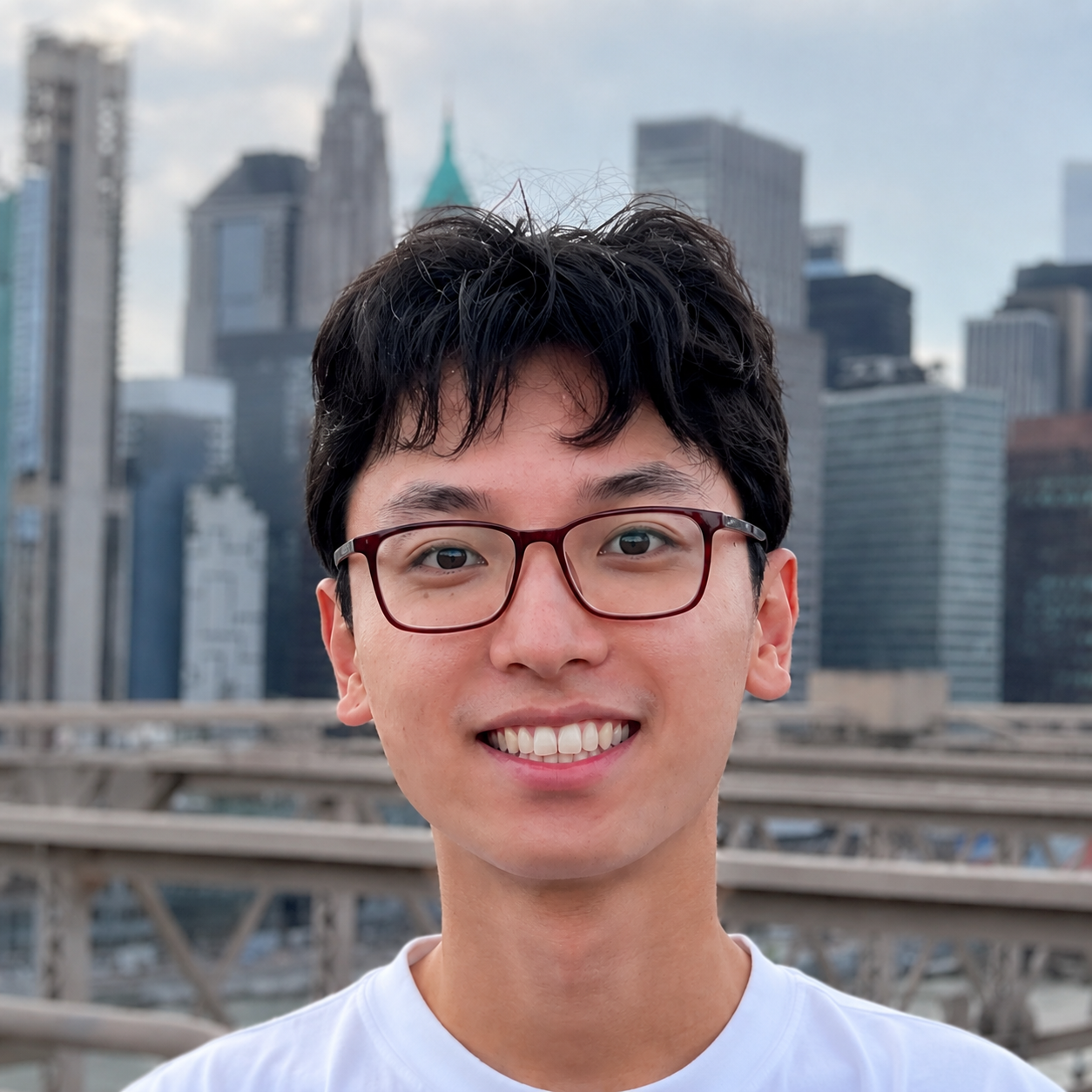
Raphael (Suk Min) Hwang
I am an undergraduate research intern at the Laboratory of Artificial Intelligence and Robotics at Sungkyunkwan University, advised by Prof. Hyeonwoo Yu. My research focuses on 3D mapping and SLAM for long-term robot autonomy. I am particularly interested in how robots can continually update their maps as environments expand and change while preserving useful knowledge under resource constraints. My current work explores memory-efficient continual learning for mapping with Gaussian Splatting.
News
Education
Sungkyunkwan University · Suwon, South Korea · Expected March 2027
B.Eng. in Mechanical Engineering & Computer Science and Engineering · GPA: 4.41/4.50
Experience
Research Intern · LAIR Lab, Sungkyunkwan University · 2025 – Present
- Co-developed range-adaptive Gaussian scale initialization, scaling Gaussian sizes with LiDAR range to improve far-range surface coverage (Keble College F-score: 51.58% → 64.02%)
- Implemented the surface-reconstruction evaluation pipeline and produced the quantitative comparisons, benchmarking state-of-the-art LiDAR mapping methods (PIN-SLAM, Splat-LOAM, Voxblox, N3-Mapping) on the Newer College and Oxford Spires datasets
Leader, Autonomous Driving Team · HEVEN Club, Sungkyunkwan University · 2024 – 2025
- Designed and implemented full-stack autonomous vehicle system (perception, planning, control) in ROS, C++, and Python
- Enhanced localization accuracy from 5 m to 2 cm by implementing RTK GNSS and NTRIP correction
- Led team to 1st Place (2024) and 3rd Place (2025) at the national Autonomous Driving Robot Race
Publications
LiDAR-GS-SLAM
ECCV 2026Real-Time LiDAR Gaussian Splatting SLAM via Geometry-Aware Covariance Coupling
A real-time LiDAR Gaussian Splatting SLAM system that couples fast G-ICP tracking with spherical rasterization-based mapping, reusing tracking covariances to drive range-aware Gaussian initialization, surface normal estimation, and complexity-based pruning/densification. It achieves 86.78% F-score on Newer College at >20 FPS with purely online trajectories.
Projects
Sensor Fusion for Autonomous Driving
Developed a LiDAR-camera sensor fusion pipeline for cone detection and color classification on an autonomous driving platform for 2025 University Mobility Competition Korea. LiDAR points are clustered via DBSCAN to extract cone centroids, then projected onto YOLO segmentation masks for color classification, improving classification accuracy by 30% over the earlier camera-first approach. Paired with a curvature-adaptive Stanley controller on an ERP42 platform for full closed-loop autonomous driving.
F1Tenth (IFAC Roboracer 2026)
Built a 1/10-scale autonomous race car with team SKKUDERIA_SKKAI for our first IFAC Roboracer 2026 appearance. Assembled the platform from a 2D SOSLAB GL5 LiDAR, a Traxxas Slash chassis, and an NVIDIA Jetson Orin Nano, and implemented the full perception–planning–control stack.
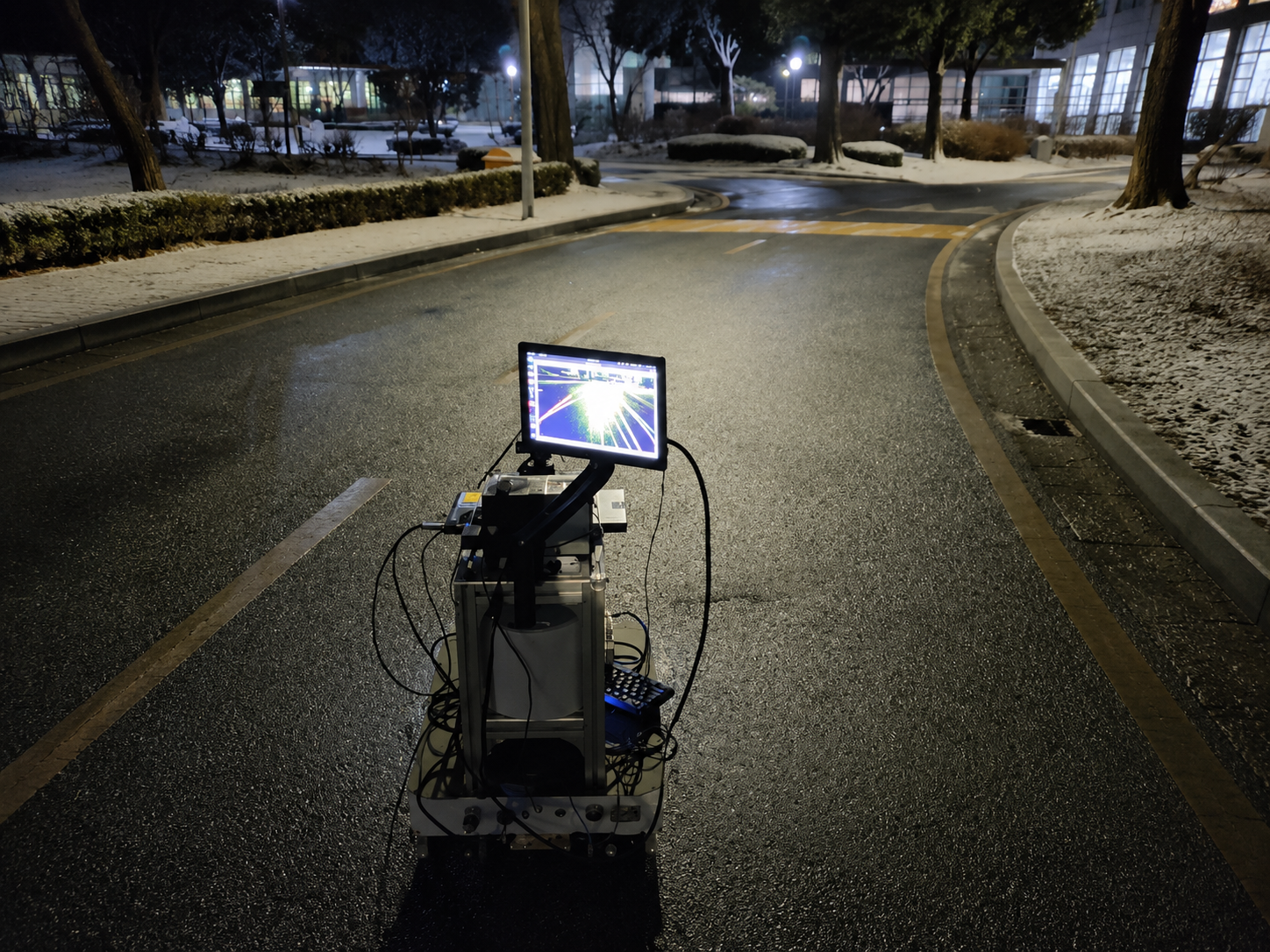
Low-Light Lane Keeping Assistance System
2024 Winter Undergraduate Research Program project building a real-time lane keeping system for low-light driving on an Agilex Ranger Mini and NVIDIA Jetson Orin. Camera frames are enhanced on the GPU by a pretrained low-light image enhancement model (Zero-DCE++) and passed to a lane detection model (SRLane), fine-tuned to stop misclassifying sidewalks as lane boundaries. Since the control computer was CPU-only, Zero-DCE++ inference was offloaded to the Jetson Orin over a wired Ethernet ROS network, lifting throughput from 0.3 Hz to 10 Hz, and the system kept the robot centered within its lane through outdoor night tests.
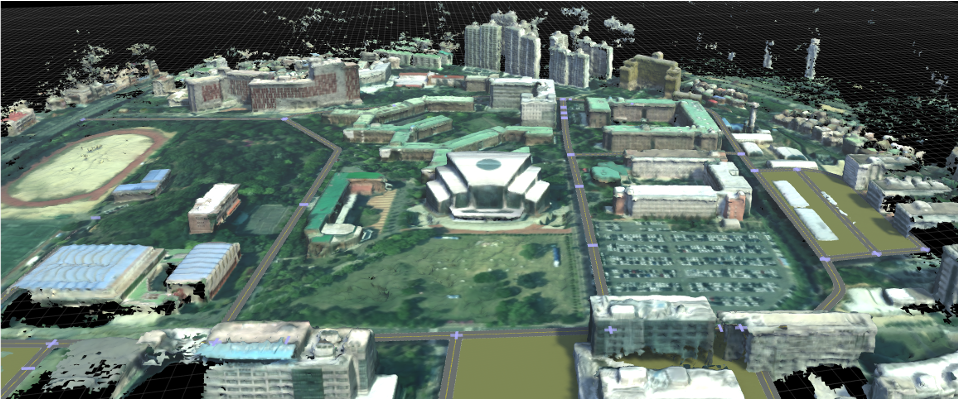
Campus 3DGS Map for Simulation
Built as the shared simulation platform for an autonomous driving hackathon hosted for HEVEN club, reconstructing the SKKU campus in 3D so six teams could build and test their own driving algorithms on a scale replica of campus roads. Google Earth imagery is processed through COLMAP for structure-from-motion and 3D Gaussian Splatting for scene reconstruction, then converted to a mesh via GauStudio. The resulting geometry was used to build a road network in RoadRunner and integrated into CARLA as the competition environment.
Honors & Awards
- National Science & Technology Scholarship (2025–2026), Ministry of Science and ICT - awarded to the top-ranked student in major during the first two years of study, full-tuition scholarship through graduation
- SKKU Chung Yong-ji Scholarship (2026) - awarded to one student across the College of Engineering for leadership, community engagement, and research initiative
- Merit Scholarship (2021–2025) - awarded to the top 4% of candidates
- Entegris Foundation Scholarship (2022)
Teaching & Service
- Teaching Assistant, C Programming, SKKU (2026)
- Instructor, Republic of Korea Air Force MAICON Military AI Contest (2025) - trained officers and cadets on autonomous driving systems
- Exhibitor, SOLiDVUE at CES 2025 - presented the LiDAR sensor’s technical details to industry and public visitors
- SG Maple (Global Mentoring & Assisting International Exchange Students), SKKU (2025)
- Interpreter, Army Military Research Institute (2022–2024) - military service